Best Portfolio Management Alternatives between Kubera, Wealthica, Finary, and Findex
December 15, 2025
11 minute read
For the modern investor, a consolidated view of one's financial life is no longer a luxury but a necessity. The proliferation of digital banks, brokerage accounts, and alternative asset platforms has made manual tracking untenable. Portfolio trackers promise a solution: a single dashboard to unify disparate accounts and provide analytical clarity. However, the market is crowded, and not all platforms are created equal, especially for investors with a global or European focus.
This analysis examines the leading portfolio trackers—Kubera, Wealthica, and Finary—and introduces Findex as a powerful, EU-optimized alternative. We will assess each platform based on the critical features that define a best-in-class wealth tracking experience.
What Users Look for in a Portfolio Tracker
The ideal portfolio tracker combines robust functionality with a clean, intuitive interface. Investors' core requirements can be distilled into four key areas:
Bank Integrations: The platform's utility hinges on its ability to connect seamlessly with a wide range of financial institutions. The breadth and reliability of these data feeds are paramount for automated, accurate reporting.
Global Asset Support: Wealth is increasingly global. A top-tier tracker must handle multiple currencies, international equities, and a diverse set of assets, from real estate and crypto to private equity stakes.
UX / Clarity: Data without insight is noise. Users demand a clean user interface that presents complex financial information in a clear, digestible format. The ability to visualize asset allocation, performance, and risk is crucial.
Cost: While value is more important than price, the subscription cost must be justifiable relative to the features provided. Investors expect transparent pricing without hidden fees.
Kubera: Strengths and Limitations
Kubera is often recognized for its clean, minimalist user experience and its commitment to delivering a unified net worth dashboard. Its interface is intuitive, allowing users to connect a wide array of accounts—including banks, brokerages, crypto wallets, and even alternative assets such as real estate, collectibles, or domain names. For those looking to track family wealth or non-traditional investments alongside stocks and mutual funds, Kubera offers a high degree of flexibility.
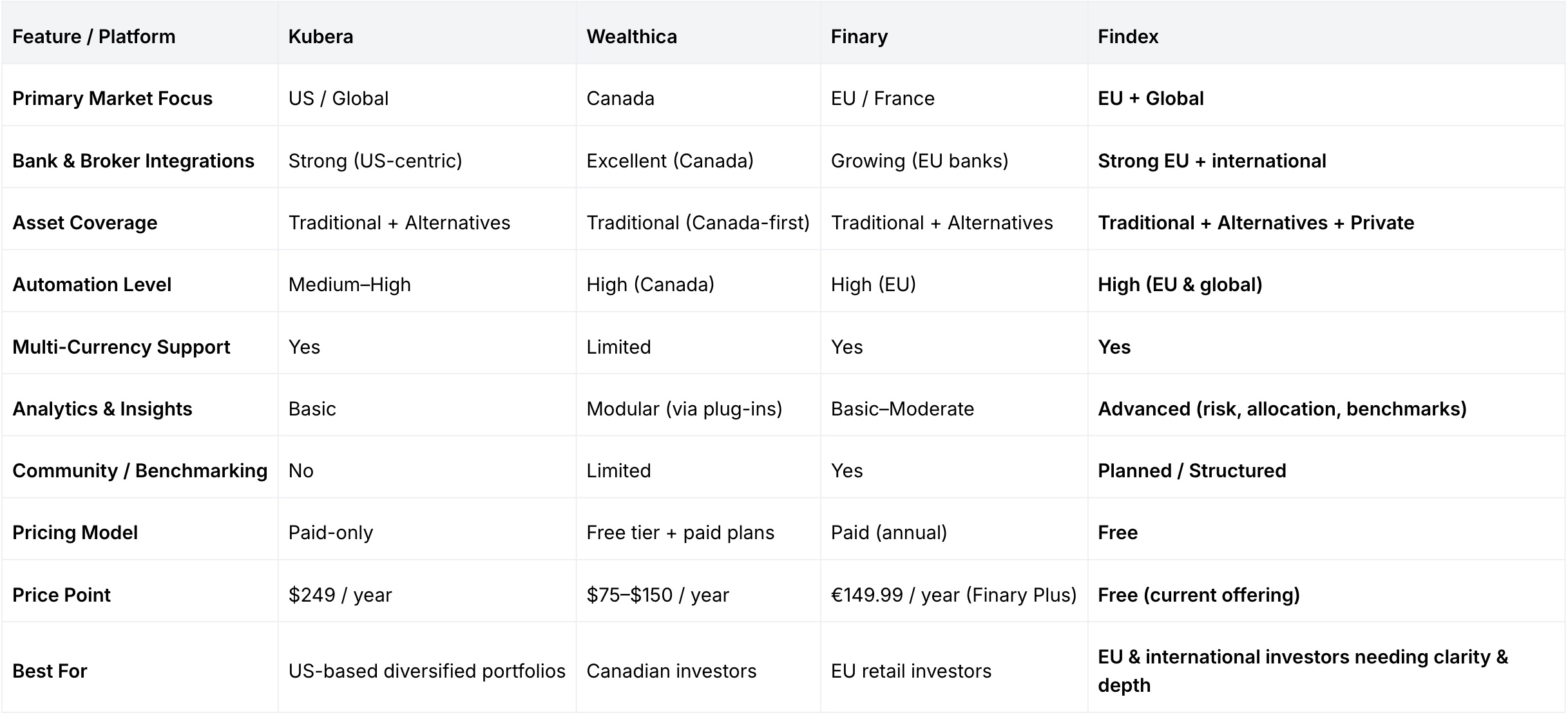
On pricing, Kubera operates on a paid-only model and charges $249 per year for its subscription. This positions it as one of the more premium options in the portfolio tracker market. The absence of a free tier may deter cost-sensitive users but underlines its commitment to privacy and an ad-free experience, with all monetization coming
Key Features and Benefits
Wide Asset Coverage: Kubera enables users to track virtually any type of asset, including cryptocurrencies, private equity holdings, vehicles, and custom assets. Its approach to asset coverage is notably broad.
Manual and Automated Data Entry: Users can connect accounts for automated data imports via supported aggregators, or enter values manually for assets that lack online integrations.
Privacy-Oriented Philosophy: Kubera markets itself as a “no-advertising, no-selling-your-data” solution, focusing on customer privacy and keeping monetization straightforward through its subscription fee.
Global Perspective: Though particularly strong for US-based users, Kubera has gradually expanded support for international accounts, aiming to be a viable option for users with global assets.
Who It's Best For
Kubera is best suited for individuals or families with complex, diversified holdings—especially those whose net worth extends across digital, traditional, and alternative assets. US investors, tech professionals, crypto enthusiasts, and users who value a holistic, customizable view of their finances will find considerable value in its offering. The platform appeals to those who prefer simplicity without sacrificing breadth, as it refrains from providing investment advice or analytics in favor of pure tracking.
Benefits
Comprehensive Net Worth Tracking: Users receive a single source of truth for their entire portfolio, reducing manual spreadsheet work and supporting better-informed financial decisions.
Ease of Use: The streamlined design prioritizes ease-of-use and visibility, helping users quickly assess their financial health.
Custom Asset Support: The ability to manually track non-standard and illiquid assets—such as art or private LP holdings—helps users who are underserved by traditional brokers.
Limitations
Limited Analytics and Insights: Kubera deliberately avoids deeper analytical tools such as performance analysis, portfolio rebalancing suggestions, or risk breakdowns. Users seeking deeper investment insights will need to supplement Kubera with other platforms.
EU and International Integrations: While Kubera’s global coverage has improved, its bank and brokerage integrations are strongest in the US and Canada. For many European users, key local financial institutions may not be supported, which can necessitate cumbersome manual updates and limit automation.
No Community Features: Unlike some competitors, Kubera does not offer networking or investor community tools for sharing knowledge or benchmarking.
Cost: The platform operates on a paid-only model with no free tier, which may deter cost-sensitive users who are accustomed to free spreadsheet tools or platforms.
In summary, Kubera excels at providing an elegant and highly customizable net worth dashboard for users with complex, multi-asset portfolios—so long as their core banks and brokers are supported. Prospective users should evaluate whether their data aggregation needs and desire for automation align with Kubera’s integration coverage and feature set.
Wealthica: Strengths and Limitations
Wealthica has established itself as the leading portfolio tracker for the Canadian market. Its primary appeal lies in its comprehensive connectivity with Canadian banks, brokerages, and wealth managers, allowing users to automatically aggregate data from dozens of institutions. For Canadian residents or investors with the majority of their assets held domestically, Wealthica presents a frictionless and robust automated solution. In terms of pricing, Wealthica starts at $75 per year for its basic plan, providing essential features at a competitive rate. A premium plan, offering enhanced capabilities, is available for $150 annually. This tiered model allows users to select the appropriate feature set based on their portfolio needs and budget considerations.
Canadian-Centric Strengths
Deep Integrations: Wealthica’s integration coverage within Canada is unmatched, supporting most major financial institutions, online brokerages, and even certain pension accounts. The platform updates automatically to reflect daily balances, positions, and transaction history, reducing the manual effort required for tracking.
Free Tier and Affordable Upgrade: Wealthica offers a functional free tier that supports core features, and a reasonably priced premium upgrade. This helps cost-sensitive investors or those seeking to “test drive” the functionality prior to full onboarding.
Custom Analytics and Plug-Ins: Wealthica supports a marketplace for plug-ins and add-ons, allowing users to customize performance dashboards, track dividends, review corporate actions, and visualize asset allocation. This extensibility appeals to users who want deeper portfolio analysis or personalized reporting.
Privacy-Focused Architecture: Some investors value that Wealthica allows account aggregation with a privacy-first mindset and limited data sharing.
Global Use Case Limitations
Primarily for Canadian Institutions: The overwhelming majority of Wealthica’s integration development is focused on Canada. For users with assets in the US, EU, or Asia, the coverage is limited—most foreign accounts must be updated manually or may not be supported at all.
Currency and Tax Handling: Investors with substantial holdings across borders may find Wealthica’s multi-currency reporting limited, and tax reporting is designed for Canadian regulatory frameworks rather than international filing needs.
User Experience Beyond Canada: For global investors or frequent travelers, the dashboard can feel “Canada-first,” with certain features, terminology, and customer support best suited to local requirements. This does not detract from its utility for Canadian investors but does limit appeal elsewhere.
Community and Support: Wealthica offers some community functions and help documentation, but global networking, cross-border benchmarking, and investor education resources are less developed compared to competitors targeting an international user base.
In short, Wealthica is an excellent choice for Canadian investors seeking automated aggregation and customizable analytics within a local regulatory and banking context. However, those seeking seamless international integration, global performance benchmarking, or consolidated overviews of truly multi-regional portfolios may find the platform’s reach limited for their needs.
Finary: Strengths and Limitations
Finary is a France-based platform that has positioned itself as a leading digital wealth tracker for European investors. The platform stands out for its contemporary design, community-driven roadmap, and steady expansion of integrations with banks and financial institutions across the EU and UK.
Finary Plus, the platform’s premium offering, is priced at €149.99 per year, granting unlimited access to advanced features such as fee scanning, sector and geographic allocation breakdowns, and wealth simulation capabilities. This transparent annual fee model distinguishes Finary from many competitors by balancing comprehensive feature access with clear, upfront costs for end users.
EU Focus and Integrations
Finary’s defining strength is its focus on serving users with European financial ties. It supports a growing list of local banks, investment platforms, and fintechs, allowing for mostly automated aggregation of both classic and alternative assets. Finary has also added support for crypto wallets, real estate, private investments, and even collectibles—delivering notable versatility for those with a diversified portfolio. The platform’s regular product updates stem largely from user feedback, which reinforces its connection to the investor community.
Analytics, Insights, and Community
Finary provides basic performance tracking, asset allocation visuals, automated currency conversion, and easy portfolio overview—all accessible through a user-friendly web and mobile interface. Its community features enable investors to compare portfolio allocations and returns against other users, ask questions, and share insights, fostering an open knowledge-sharing culture which is rare in many competitors.
However, while Finary makes it easy to see valuations and track net worth progression, its analytics suite is more elementary compared to platforms with an institutional or professional focus. Advanced tools—such as deep risk analytics, custom reporting, or scenario modeling—are either not present or only available under premium tiers. For users prioritizing detailed historical analysis, multi-layer benchmarking, or customizable metrics, this may present some limitations.
Finary’s transparency and educational resources are growing, but some users have indicated a desire for more guidance in interpreting their financial data, as well as expanded learning content on asset management and risk. While the platform is robust for EU residents, investors with international assets or who require consolidated performance comparisons across multiple currencies and jurisdictions may still need to supplement Finary with additional tools.
In summary, Finary is a compelling option for European investors seeking a simple, visually engaging, and community-driven experience. Its strengths lie in seamless aggregation and user empowerment; prospective users should weigh these against the current depth of analytics and global asset integration, depending on their portfolio needs.
The EU-Optimized, International Alternative: Findex
Findex is engineered to resolve the core challenges faced by today’s investors—whether in Europe or globally—by addressing the persistent pain points that undermine portfolio confidence and efficiency. Its platform delivers a structured, high-clarity solution to fragmented, manual, and opaque wealth tracking. Notably, Findex currently offers its platform free of charge, providing a significant cost advantage over paid competitors such as Kubera, Wealthica, and Finary. Its platform delivers a structured, high-clarity solution to fragmented, manual, and opaque wealth tracking.
Comprehensive Asset Aggregation and Global Integrations: Findex unifies assets held across multiple banks, brokerages, and neobanks—covering both EU institutions and an expanding list of global connections. This directly tackles the problem of unstructured portfolio management, eliminating the reliance on manual spreadsheets and providing a single, real-time view across all accounts and asset classes. Multi-currency support ensures precise reporting even for internationally diversified portfolios.
Automated Tracking and Efficiency: Manual updates and data entry are replaced by seamless, automated aggregation. Findex’s system imports balances, valuations, and transaction data, saving time, reducing errors, and granting continuous oversight—no matter how complex or geographically dispersed the holdings.
Deep Analytical Insights and Benchmarking: Beyond simple asset lists, Findex provides detailed analytics on performance, diversification, risk exposure, and sector allocation. Investors can visualize allocation drift, benchmark results against indices, compare global and regional assets, and access performance indicators that inform rebalancing strategies. This directly addresses the pain points around lack of insights, poor analysis tools, and difficulty tracking true progress over time.
Professional-Grade Reporting and Workflow: Reporting is clear, structured, and audit-ready, making it easier to provide overviews to advisors, accountants, or co-investors. Integrated benchmarking, exposure visualizations, and risk dashboards support more informed decision-making, while helping users stay aligned with long-term strategy and compliance requirements.
International Capability, European Precision: While optimized for European users, Findex’s design and feature set position it as a leading choice for international investors requiring integration across borders as well as the rigor of institutional systems. Whether tracking listed equities, alternatives, or private holdings, Findex bridges the gap between local regulatory needs and global investing ambitions.
Findex combines EU-focused optimization with international reach—streamlining portfolio management, reducing errors, enhancing insights, and providing real-time tracking and reporting for investors everywhere.
written by
Findex Team
Sign up for Early Access!
Experience the future of self serviced private banking.
Thank you! We've added you to the early access list. We'll get back to you if you're selected!
Oops! Something went wrong while submitting the form. Try again